2026 Mobile Industry Predictions: Insights from Cédric Foray of EY
EY's Global Telecommunications Leader shares his vision for AI-native operations, satellite connectivity, and the strategic priorities operators must embrace in 2026.
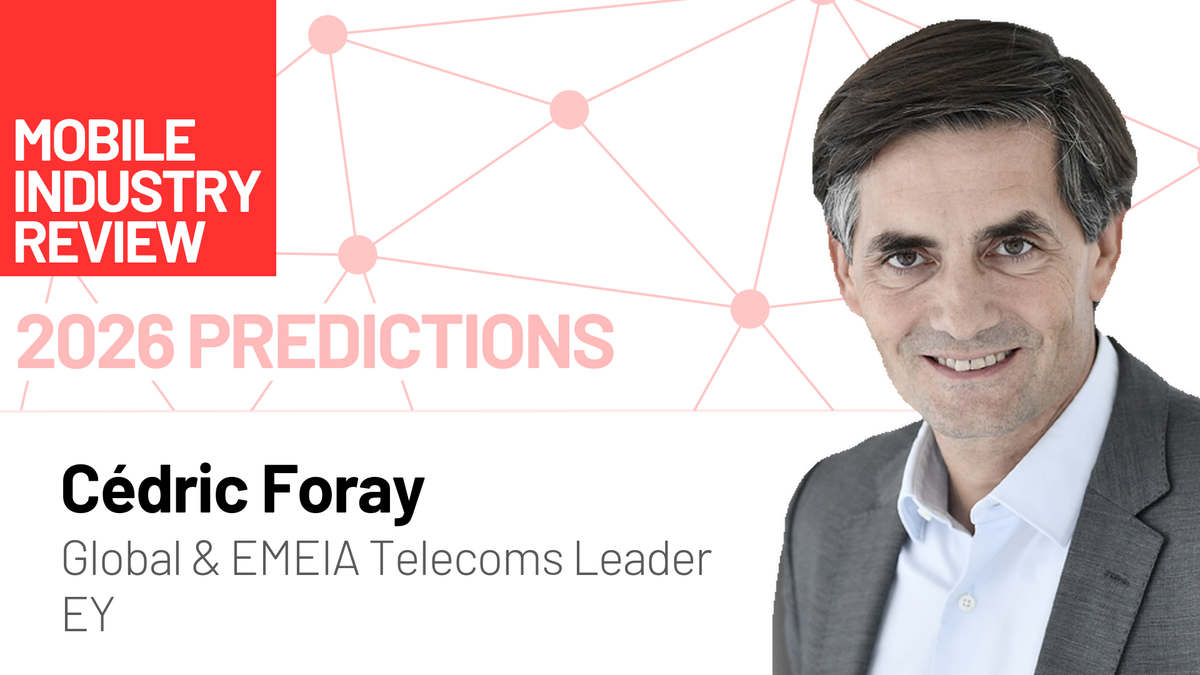
We spoke with Cédric Foray, EY Global and EMEIA Telecommunications Leader at EY, about the transformative forces reshaping the mobile industry in 2026. With deep expertise across assurance, strategy, and consulting services for telecommunications operators worldwide, Cédric offers a compelling vision of how AI and satellite connectivity will redefine network economics and customer value.
Over to you Cédric - my questions are in bold:
What's the biggest shift you expect across the mobile industry in 2026?
In 2026, the mobile network will gain brains and wings. AI will move from pilots to the network's control layer, powering autonomous planning, assurance, and energy optimisation. At the same time, direct to device satellite connectivity goes mainstream, reshaping coverage economics. These twin shifts—AI native operations and non-terrestrial network commercialisation—aren't incremental upgrades; they will redefine how networks deliver value. Expect smarter experiences, new monetisation models, and resilience as a differentiator. For operators, vendors, and policymakers, 2026 is the year connectivity becomes intelligent and borderless.
Which emerging technology will have the most practical impact on operators, MVNOs, and the companies that support them?
The most practical impact in 2026 will come from AI capabilities scaling across different business functions. GenAI and agentic AI will transform customer operations, not only in customer care but also through embedding in sales functions. AI's role in network management and optimisation will also gain wider traction, scaling further as operators migrate to 5G Stand Alone and 5G Advanced infrastructure. Meanwhile, AI will also play a more compelling role in enterprise service portfolios. While partnerships with AI specialists will help telcos bring new offerings to market, many operators can also translate internal AI capabilities and learnings into enhanced B2B value propositions.
What customer behaviours or expectations will most challenge mobile operators and service providers?
We see three interrelated trends in the consumer market. Hyper-personalisation will accelerate, with customers demanding real time, tailored experiences—dynamic pricing, personalised bundles, and frictionless onboarding—powered by AI yet fully transparent. Secondly, value sensitivity will co-exist with premium demand: some households may resist price hikes but will pay for differentiated experiences if value is clear, forcing operators to simplify propositions and innovate beyond connectivity. Third, sustainable and inclusive services will act as a differentiator: green credentials and equitable access are now decision drivers, especially for Gen Z. On the B2B side, heightened demand for security capabilities and AI embedded in service delivery will also emerge as key attributes businesses look for in their connectivity providers. Telcos that effectively orchestrate partner ecosystems while delivering frictionless customer interactions stand to gain.
What risks or blind spots do you think the industry is underestimating as we move into 2026?
Based on our Top 10 risks study, the mobile industry faces a set of interconnected blind spots that could derail transformation if left unchecked. Privacy, security, and trust remain the top risk, amplified by stricter AI governance and consumer anxiety. Ineffective technology adoption—treating AI and Open RAN as bolt ons rather than operating model shifts—threatens ROI. Geopolitical and supply chain fragility adds uncertainty to vendor strategies and hyper-scaler alliances, while energy economics and sustainability gaps risk margin erosion as power costs rise. Finally, digital safety expectations—from harmful content to data misuse—are reshaping customer trust and regulatory landscapes. These risks don't sit in silos; they intersect. Leaders must embed resilience into service and organisational design and treat trust, sustainability, and agility as strategic levers.
If you were advising a mobile operator's leadership team today, what strategic priority should they focus on to stay competitive in 2026 and beyond?
Effective strategies will hinge upon exploiting new sources of value creation while understanding how the mobile industry value chain itself is evolving. Leadership needs a clear view of the different scenarios informing changing market structures, from an accelerating consolidation outlook through to the emergence of new partnership opportunities. At the same time, operators should be as proactive as possible when exploring new forms of mobile connectivity, from direct-to-device satellite capabilities through to network APIs and fixed wireless access.
Thank you Cédric!
You can connect with Cédric on his LinkedIn Profile and find out more about the company at www.ey.com.