2026 Mobile Industry Predictions: Insights from Nick Petheram of Nomia
Nick Petheram, CEO of Nomia, explores how tail spend management, AI paired with human intelligence, and supply chain resilience will shape mobile operator strategy in 2026.
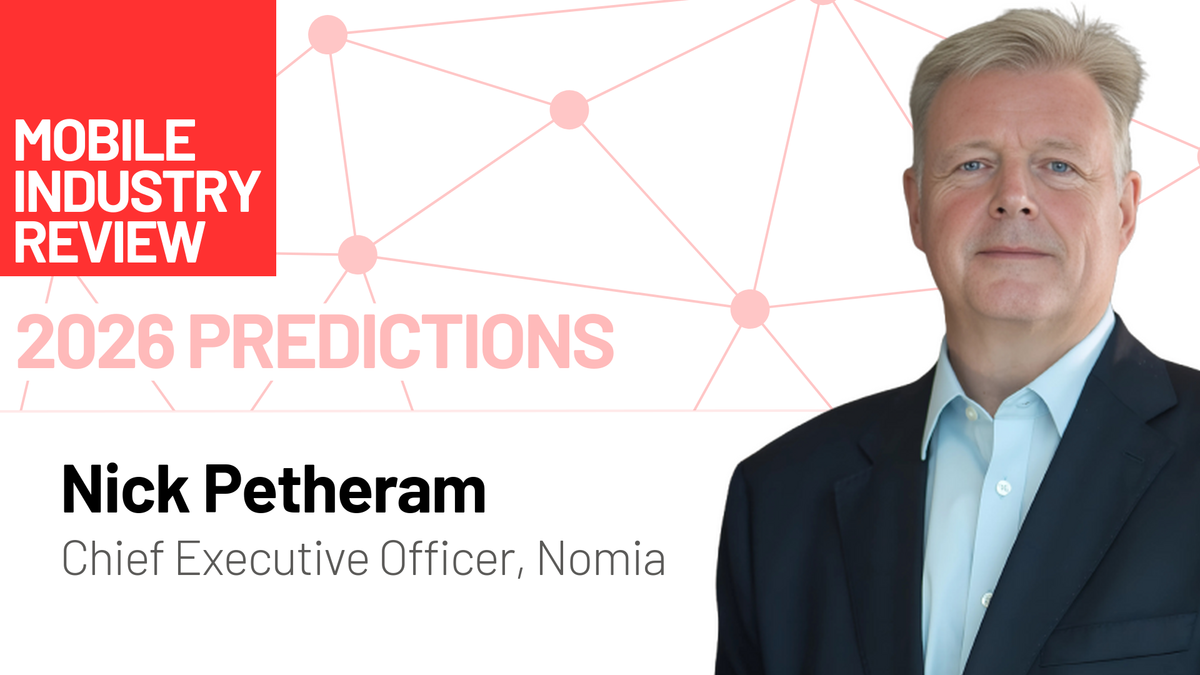
I spoke with Nick Petheram, Chief Executive Officer of Nomia, about shifts he believes will shape the mobile industry in 2026 – not just in network strategy, but in the procurement and supplier decisions that sit behind operational resilience and customer trust.
Nick shares what he and his team are increasingly seeing in conversations with operators: that tail spend, the vast layer of low-value, high-volume spend across every telecom enterprise, is increasingly where they win or lose on compliance, ESG expectations and execution speed.
Over to you Nick - my questions are in bold:
What's the biggest shift you expect across the mobile industry in 2026?
One of the shifts we are seeing emerge as we move into 2026 is the industry finally treating tail spend as a strategic priority – because risk, compliance, and resilience are increasingly shaped by whether operators have visibility and control across thousands of smaller, long-tail transactions.
For years, operators focused procurement attention where you'd expect: network infrastructure, spectrum, core IT – the big-ticket strategic spend categories. But in 2026, the bigger challenge will be controlling what happens outside that core: the thousands of low-value, high-frequency purchases that sit across regions, subsidiaries, business units, and partner ecosystems. Tail spend – like specialist field services, niche software tools, local network components – might only represent around 20% of total third-party spend, but it can account for up to 80% of transactions. It is often where process complexity, inconsistent controls, duplicated buying, and supplier exposure can quietly accumulate.
For mobile operators, this matters because the smallest vendor transaction can still carry outsized regulatory, reputational, and operational consequences. As regulation tightens and ESG scrutiny rises, closer tail spend management becomes a business necessity. Tail spend is increasingly moving from a back-office concern to a lever for control, agility, and governance.
Many operators are starting to explore new procurement models that deliver better decisions, stronger oversight, and clear accountability at scale.
Which emerging technology will have the most practical impact on operators, MVNOs, and the companies that support them?
Building on that, the key technology shift is AI. Not "AI" in the abstract, but AI that is paired with human intelligence in an end-to-end procurement model. That's where the real impact lands.
There's a growing industry understanding that AI delivers the most value when paired with human expertise. AI is powerful at processing and pattern recognition, but procurement decisions aren't purely data decisions – they involve nuance, negotiation, trade-offs, and accountability. That's why what appears to be working best in practice is AI and human intelligence (HI) operating together: AI for speed and scale, HI for context and judgement.
Mobile telecoms and MVNO Operators are complex multi-market procurement organisations. AI can surface the risks and opportunities hidden inside that complexity – like supplier overlap, renewals, pricing inconsistency, or unmanaged spend across tower and network maintenance suppliers. But human expertise is what makes those insights usable: validating recommendations, correcting supplier choices based on local delivery realities, negotiating better terms, and ensuring every decision aligns with policy and procurement standards.
For operators and MVNOs, the practical result is faster, more compliant procurement that ultimately reduces friction, cost leakage, and service-impacting vulnerabilities across the whole partner and supplier ecosystem.
What customer behaviours or expectations will most challenge mobile operators and service providers?
Customers now expect operators to deliver two things simultaneously: hyper-personalised, always-on service, and demonstrable trust.
Consumers and enterprise customers are becoming less tolerant of service disruption, security lapses, or slow responsiveness. And those outcomes aren't driven only by network performance. They're increasingly shaped by the resilience of the operator's entire supplier base – including smaller vendors delivering software, maintenance services, specialist parts, customer support tools, or field services. Tail suppliers are often where controls are lightest, even though the impact on customers can be strong.
At the same time, customer expectations around ESG and ethical sourcing are accelerating. More than ever, telecoms operators are expected to demonstrate that their supply chains – not just their operations – meet standards around sustainability, security, and accountability.
In practice, trust is increasingly shaped as much by the supply chain as by the network.
What risks or blind spots do you think the industry is underestimating as we move into 2026?
An area the industry is increasingly reassessing is where procurement exposure truly sits, understanding that, in reality, the riskiest vendor is often the one you're not tracking.
Tail spend is where organisations lose visibility: non-contracted suppliers, inconsistent onboarding, purchases made outside procurement processes ("maverick spending"), and weak controls around ESG or data protection. And because each transaction is small, it doesn't trigger attention – until something goes wrong.
For industries with high regulatory oversight, including telecoms, the consequences can be magnified because operators are accountable to governments and public authorities. A small purchase order from a non-compliant vendor can still create major fallout – legal exposure, audit failures, reputational impact, or even national infrastructure concerns.
Another blind spot is the assumption that AI automatically solves this. AI can absolutely help, but relying on automation without oversight becomes a new vulnerability – governance still needs accountability.
If you were advising a mobile operator's leadership team today, what strategic priority should they focus on to stay competitive in 2026 and beyond?
A clear strategic priority for leadership teams is building procurement control that can scale – so you can move quickly without losing visibility.
In 2026 and beyond, competitive advantage won't come only from network build-out, or even pricing. It will come from how quickly and safely an operator can adapt – across markets, technologies, and regulations.
To do that, leadership teams need to modernise procurement at the edge:
- Bring fragmented tail spend into a single, auditable supplier framework
- Reduce the supplier sprawl that creates inefficiency and compliance gaps
- Strengthen onboarding, due diligence, contract governance, and ESG reporting
- Use AI for speed and analytics, but keep human expertise in the loop for judgment and accountability
We are already seeing leading global organisations, including Vodafone, actively transforming their tail spend models to tighten supplier management, improve governance, and free procurement teams to focus on strategic priorities across global operations.
From what we are seeing, tail spend is increasingly recognised as more than a procurement challenge. It is becoming a question of control that many operators are now actively addressing. And in the mobile industry, control translates directly into fewer surprises, faster execution, stronger audit readiness, and better customer outcomes.
Thank you Nick!
You can connect with Nick on his LinkedIn Profile and find out more about the company at nomia.com.