2026 Mobile Industry Predictions: John Hughes, Enea
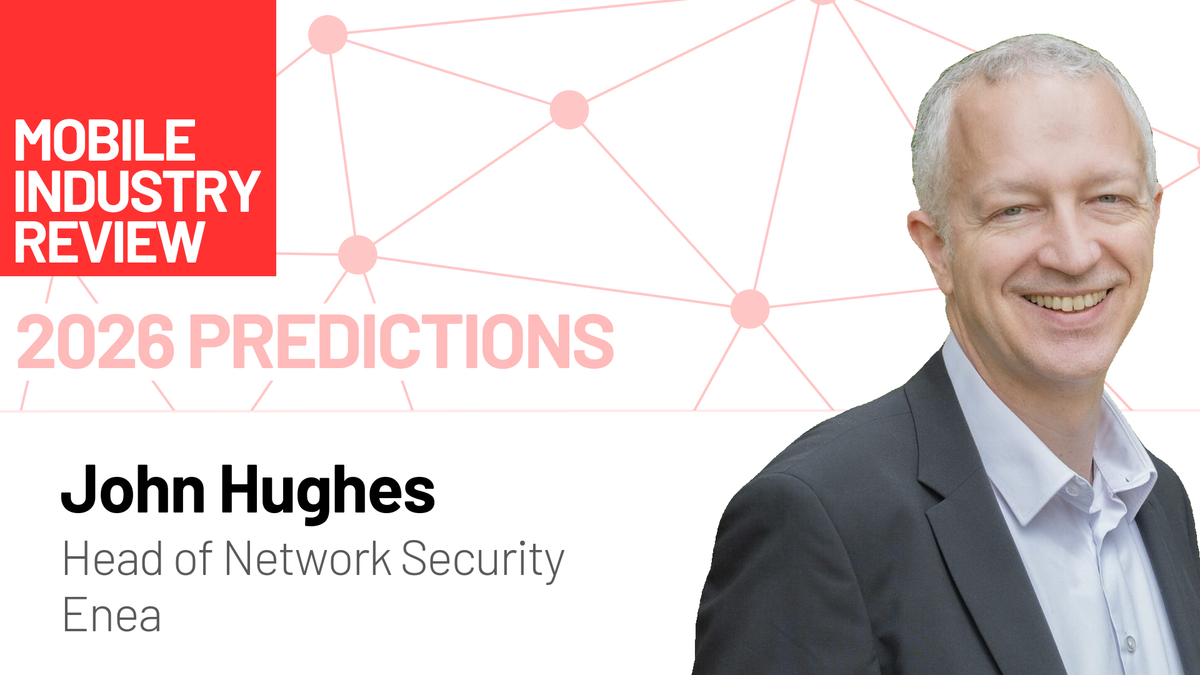
John Hughes, Head of Network Security at Enea, shares his predictions for the mobile industry in 2026.
Over to you John - my questions are in bold:
What's your prediction for satellite connectivity in 2026?
In 2026, we will see satellite connectivity going more mainstream. The number of competing groups trying to catch up with Starlink's first mover advantage is increasing, with notable tie-ups between Apple with Globalstar, Vodafone with AST SpaceMobile coming online to match T-Mobile's T-Satellite launch in mid-2025. As the device and eSIM market evolves, more people will be able to connect easily.
It won't give the same bandwidth needed, but we will now see integrated data plans with cellular and Wi-Fi coverage offering more universal service. We are at the early stages here with 30+ services in operation today and already another 30 scheduled for 2026 launch. Low earth orbit satellite expansion is inherently linked with AI, primarily for operational efficiency but also now for cybersecurity, with additional questions on the sovereignty of data gathered at the space edge.
As satellite goes mainstream and enters the collective consciousness of users, we only see this market expanding. The price point for this additional service will also be interesting to watch. T-Mobile offers it as an add-on at $10 USD a month with specific applications enabled; in New Zealand, One.NZ offers rural data plans with satellite for the equivalent of $28 USD per month. Orange have recently announced an SMS plan add-on at €5 a month with Skylo, and a data plan set to follow.
How do you see AI evolving in the telecom sector next year?
The reality of AI is with us – it has had a significant business impact in 2025. In telecom, there has been a lot of focus on automation and customer relationship management. In 2026, AI will be using more customer and network data with supervised learning to get more operationally focused, both in prediction and reaction to build a better, more secure connectivity experience. The potential objections on the grounds of GDPR and data sovereignty have to be answered for telecom, as well as the core 'fit for purpose' questions.
It takes time and experience for operations teams to trust systems, but in 2026, we should see this gap being closed for AI-based systems as teams get to grips with the reality of the technology, the data needed for AI to learn, and solutions where it has the most impact.
What's your outlook on telecom regulation and its impact on US tech companies?
The implementation of UK and EU telecom regulation began to bite in 2025, with US tech companies found to be in breach of legislation from both UK regulator Ofcom and the EU Digital Services Act. The latest issue was the proposed fine for X of $120m USD for breaches of advertising rules. Combined with the French regulator's €150m Euro fine for Apple in 2025, also for advertising, and the recent announcement that the EU is starting an investigation into AI search engine responses with Google.
This can be interpreted in two ways – as the right of the regulator to make and enforce business rules in their jurisdictions or, alternatively, as an attack on US corporations by over-regulation.
The threatening escalation is in trade, tariff disputes and open markets. 2026 will see how much teeth the regulator has, what their enforcement options are, how they will race to catch up with AI, and the challenges both in courts and politically between the US administration and the EU.
A2P SMS pricing has been volatile – what do you expect in 2026?
Is 2026 the year when rising international A2P SMS termination fees finally hit back at operators? Many mobile network operators have continued increasing International Termination Rates in an effort to boost A2P revenues. But beyond a certain threshold, prices gone wild have the opposite effect: they drive traffic away.
By the end of 2025, average ITRs exceeded $0.14, a critical tipping point. Above this level, SMS volumes decline sharply. In fact, traffic already begins to fall once prices rise above $0.10 per message. On average, every $0.01 increase beyond $0.10 results in a 2.9% drop in traffic, with the steepest declines occurring between $0.14 and $0.20.
Prices are expected to remain elevated in 2026 and may even continue climbing. But 2026 is also likely to be the year when network operators begin testing smarter, value-based pricing models to counter revenue erosion. With AI-driven messaging intelligence now capable of classifying traffic into critical vs. non-critical categories, operators can align costs with actual message value and bill accordingly. The upside is substantial: smart pricing can increase A2P SMS revenues by up to 130%.
In the meantime, as the market waits for intelligent pricing models to gain traction, the broader messaging ecosystem will look for alternatives to keep brands engaged. Rich Communication Services for business is one potential path, offering richer experiences that many brands should begin shifting budget toward.
Will 2026 be the year RCS finally takes off?
We should expect Rich Communications Services for business to enter a stronger growth phase in 2026, driven by broader operator adoption, maturing standards, and Apple's gradual rollout of RCS on iOS. Together, these factors significantly expand reach and increase confidence among brands. The FIFA World Cup 2026 is also likely to serve as a major catalyst, showcasing the value of RCS on a global scale.
As RCS adoption rises, we'll see an explosion of rich media in business messaging, much of it created or optimised using AI. AI will also power the design of conversational flows and enable hyper-personalised customer experiences by leveraging behavioural and contextual data.
But spammers always follow users. As traffic shifts toward RCS, we can expect AI-generated spam and smishing campaigns to grow, with content that is increasingly believable, personalised, and coercive. This will make robust RCS security and advanced threat detection more critical than ever.
With recent high-profile breaches, how is executive accountability changing?
South Korea has long been held as the canary in the coal mine for the world economy due to its high-tech manufacturing base and export-driven industries. But could it also now be the same for data breaches and cyberattack?
In 2025, three Korean CEOs have accepted responsibility due to large data breaches, representing an unacceptably large loss of data and an existential threat to their business: the CEO of Korea Telecom, the CEO of South Korea Telecom, and the CEO of e-commerce giant Coupang. Each CEO took ultimate responsibility for the loss of data and trust. The fate of telecom giant LG Uplus' CEO remains uncertain after they were victims of a recent cyberattack.
In Europe, with the advent of NIS-2 into legislation, we are seeing that vendors found responsible for cybersecurity-related outages could also be held responsible for damages indirectly incurred by organisations using their software, if appropriate checks and safeguards are found to be lacking.
We don't expect that the frequency of cybersecurity incidents will decrease in 2026, but with the potential financial ramifications becoming clear in class-action lawsuits, shareholder activism and NIS-2 legislation being enacted, we do expect that for more CEOs, in the words of US President Harry Truman, "The buck stops here." It is more than duty and honour – it is about organisational cyber health in 2026.
Thank you for taking the time to contribute John!
Read more about John on his LinkedIn Profile and find out more about Enea at www.enea.com.