Inside spusu UK: A Q&A with Managing Director Christian
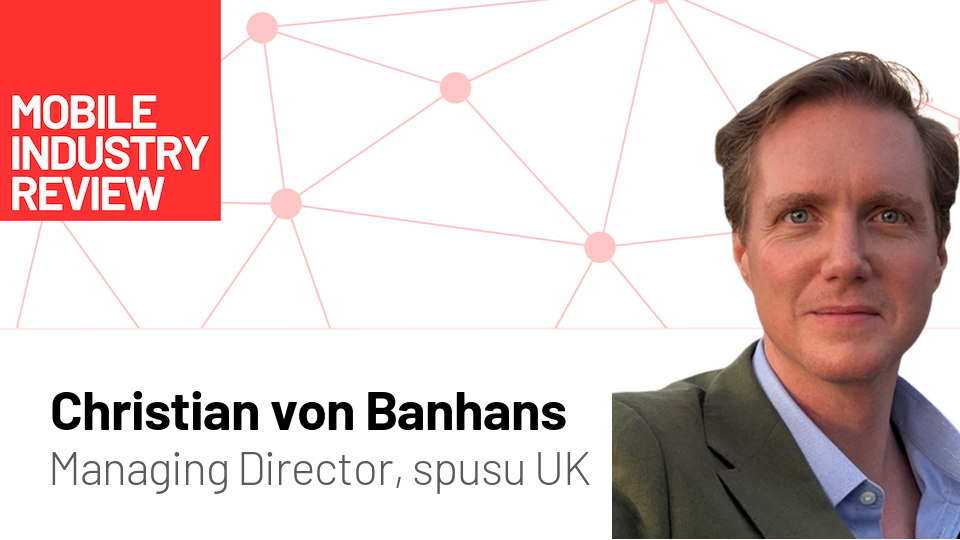
Today we're meeting Christian von Banhans, Managing Director at spusu UK.
spusu is one of the newer names in the UK mobile market, but it’s been earning a reputation for transparent pricing, fair SIM-only plans and a refreshingly human approach to customer support.
I’m speaking with Christian to explore how spusu is carving out a space in a crowded market - and why simplicity still matters in an industry known for complexity.
By the way, do check out their price plans. You might be surprised. I'll put a screenshot below.
Over to you Christian - my questions are in bold:
Who are you and what's your background?
I grew up in London and studied in Austria. As a technician at heart, my zest for natural sciences was strong in my youth, which is why I turned to mathematics as my first field of study after school. My greater personal interest was always in managing IT however, so my first gig as an entrepreneur was in my early twenties offering IT services and IT audits for larger firms with my business partner.
That path led me on a journey through technical sales at the original spusu in Austria (then called Mass Response Service) and subsequently onto a master's in business administration. After becoming academically qualified to manage firms, I was then called into the role as the managing director of further spusu subsidiaries in Germany and Italy. The international focus of my work has inspired me to fulfil an old dream of mine and starting a PhD, alas not in a natural science, but in international business. I'd now consider myself a veteran in the telecommunication and software industry, with more than 15 years of experience.
In this time, I've garnered experience in both B2C and B2B markets, and I've come to feel at home across Europe thanks to the international nature of my background, work and ability to speak multiple languages including German, conversational Italian and very rusty French. I'd go so far to say that I speak Python better than French!
What is your job title, and what are your general responsibilities?
As the managing director of spusu UK, I'm responsible for leading the company's overall strategy, operations and growth. I ensure that everything we do reflects our brand vision — providing customers with simple, transparent and high-quality mobile services.
I act as the main point of contact for our partners, regulators and internal teams, helping to align commercial objectives with customer needs. A large proportion of my role also focuses on expanding our UK presence, acting as the main contact for key stakeholders and ensuring we deliver a positive, valuable experience for every customer who joins us.
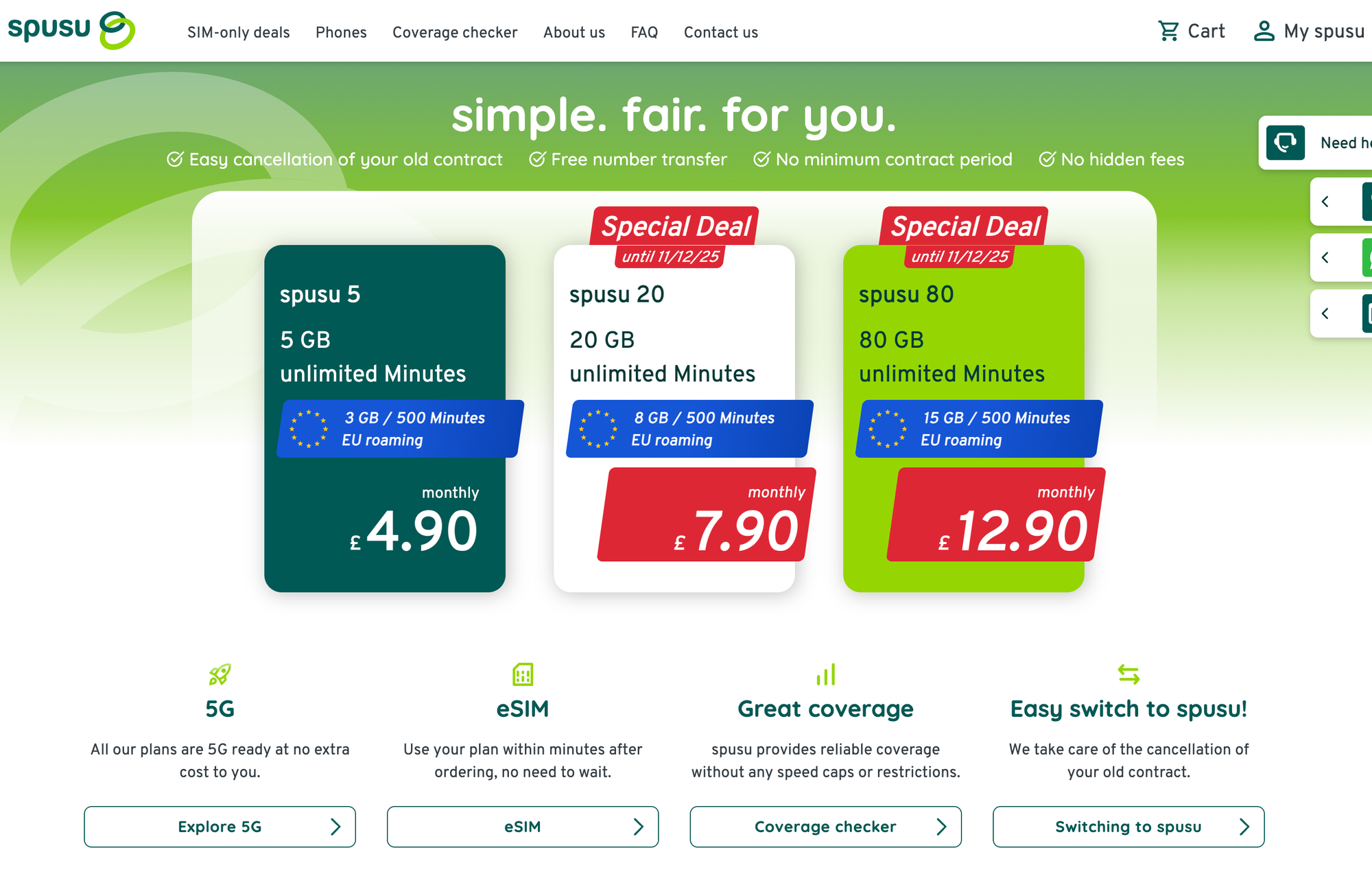
Can you give us an overview of your business and what drew you to lead the organisation?
spusu is a SIM-only mobile provider, which was founded in Austria in 2015, but launched in the UK in 2023. This was when I became UK managing director. Our motto is 'simple. fair. for you.' and we strive to reflect that in our business strategy. I was approached by the previous managing director of spusu Austria, who offered me a job. Intrigued, I queried what positions someone with a thorough perception of technology and interest in solving practical business problems could fill. And here I am today. I took up the opportunity in my mid-twenties and have not regretted it since. I have had input on a few areas of the business from head of sales to becoming the spearhead of international expansion of the company.
Ultimately, at spusu, we keep things simple, by eliminating confusing contracts and unexpected additional fees. Aside from that, we prioritise the customer experience, from their journey on our website to external support, we take a human-first approach to customer service so that every query is answered by an expert human agent instead of an AI chatbot. By doing things differently, we stand out from our competitors.
Who are your target customers? What's your revenue model?
Our target audience is anyone in the UK who uses a mobile phone. We believe that great connectivity and fair pricing shouldn't be exclusive — so our offers are designed to appeal to a range of demographics, from light users to heavy data consumers. We operate a rolling monthly subscription model, which gives customers complete control of their plan, with the flexibility to stay as long as they require without being tied into lengthy contracts. It's a straightforward, transparent approach built around flexibility, trust and value for money — qualities that resonate with today's customers, who are growing increasingly tired of complex plans and mid-contract price rises.
What's the most challenging problem your team has solved recently?
Earlier this year, we rolled out VoLTE and WiFi Calling support for a range of less-popular mobile devices and we are still actively working on expanding that list further. It takes a lot of work, patience and technical industry expertise to develop the mobile core, but our team is handling it wonderfully.
If you had a magic wand, what one thing would you change in the mobile industry?
There are a few things I'd change if I had a magic wand!
Firstly, I'd end CPI-linked price rises and long, restrictive contracts. Instead, I'd like to see a move towards simpler, transparent pricing and flexible 30-day terms.
Next, I'd make human-first customer support an industry standard — something spusu is often praised highly for. Although the industry has made great strides in technology, I think that AI bots fall short when it comes to their use for customer support. For a sector built on connectivity, it's ironic how hard it can be for customers to get through to their provider and get the answers they need!
What is your message for the larger players in the mobile industry marketplace?
My message would be to focus wholeheartedly on the customer experience. Too often, we see industry players try to differentiate through added features that rarely make a valuable difference to the customer experience. I really believe that to stay competitive, less is more. Providers should focus on what matters most to customers — that's simplicity and reliability in every aspect of consumers' customer experience — from clear pricing and strong coverage to responsive customer support.
Where do you get your mobile industry news from?
As the managing director of a mobile provider, I think it's vital to keep in touch with what's happening in the industry. Afterall, knowledge is power. I always familiarise myself with the latest first‑party regulatory updates from Ofcom, I read Mobile World Live for daily operator and network insights, 3GPP's news for industry standards milestones. And for a lens into the operator world, my go-to's are ISPreview and Mobile Industry Review, of course.
Can you list 3 people you rate from the mobile industry that we should be following on LinkedIn, and why?
I'd recommend Kester Mann as he connects board‑level strategy to consumer reality. This is useful for calibrating product roadmaps, partnership talk, and competitive positioning.
Karen Egan's work keeps us grounded in facts (and in what Ofcom and the CMA actually care about). Pairing her notes with Ofcom's pricing data can help sanity‑check operator claims.
And finally, I'd recommend Ewan Macleod. His lens is relentlessly practical. How does something affect the customer experience and what actually works in market? It's a useful counterweight to press‑release spin and spreadsheet‑only analysis.
What are your go-to mobile apps for both work and personal use?
My go to mobile apps to enable my day-to-day work on the go include Microsoft Teams, which is crucial for collaboration and keeping in touch with my team, and OneDrive cloud storage means I can access documents across devices and large files remotely. This shouldn't come as a surprise, but for any professional within this industry, LinkedIn is fundamental. I find it especially powerful for networking, keeping in touch with partners and exploring industry trends.
The Uber app is a lifesaver for me and gets me from A to B most days, while Google Maps helps with navigation and finding local services while I'm travelling. I would recommend Speedtest by Ookla as a must for anyone testing mobile networks for performance, bandwidth and latency. Obsidian note taker is also super helpful for me, as it stores all notes as plain text Markdown files on your device, which can be linked together for visual ideas mapping.
My personal apps include Spotify for music and podcasts. I listen to a broad range of podcasts, from contemporary history to profiles of current leaders and successful businesspeople up to the occasional true crime story. I enjoy 20-30 minute episodes; long enough to contain relevant content and short enough to consume on the go or while waiting for a train or plane. I also rely on Wellhub, a health and wellbeing aggregator, which collates my fitness classes, bookings and wellness resources in one place — perfect when I need some downtime!
Tell us about your approach to mobile devices - what do you use and what drives your upgrade decisions?
I primarily use iOS, but I like to keep an eye on both ecosystems to stay up to date with platform developments. I try not to upgrade impulsively, but I usually run a current-generation device because we're continually testing network capabilities such as VoLTE, Wi-Fi Calling and eSIM provisioning. My upgrade decisions are influenced by performance — particularly battery life, modem efficiency and camera reliability — features that genuinely improve my daily experience.
What's the best new mobile technology product or service you've seen recently?
One of the most exciting developments I've seen recently is direct-to-cell satellite connectivity. This is the ability for standard smartphones to connect via satellite without the need for specialist hardware. As this technology scales through initiatives such as Starlink's Direct to Cell and emerging operator partnerships, we're moving closer to a world where "no signal" is (hopefully) no longer a common frustration! It's a deceptively simple concept that can improve safety, accessibility and continuity of service for users.
Finally, let's talk predictions. What trends do you think are going to define the next few years in the mobile industry?
I think that AI will eventually permeate every layer of the mobile experience, reaching virtually all demographics. I expect we'll see huge growth in data consumption driven by AI-powered image and video generation, as well as personalised content.
At the same time, I expect to see a growing counter-movement focused on digital wellbeing as consumers are actively seeking more ways to reclaim time, focus and human connection away from their devices. The next few years will be defined not only by how deeply AI integrates into mobile life, but also by how consciously and responsibly we choose to engage with it.
Thank you Christian. Connect with Christian on LinkedIn and read more about spusu UK at their website.
Now, I said I'd put a screenshot below of the spusu price plans...
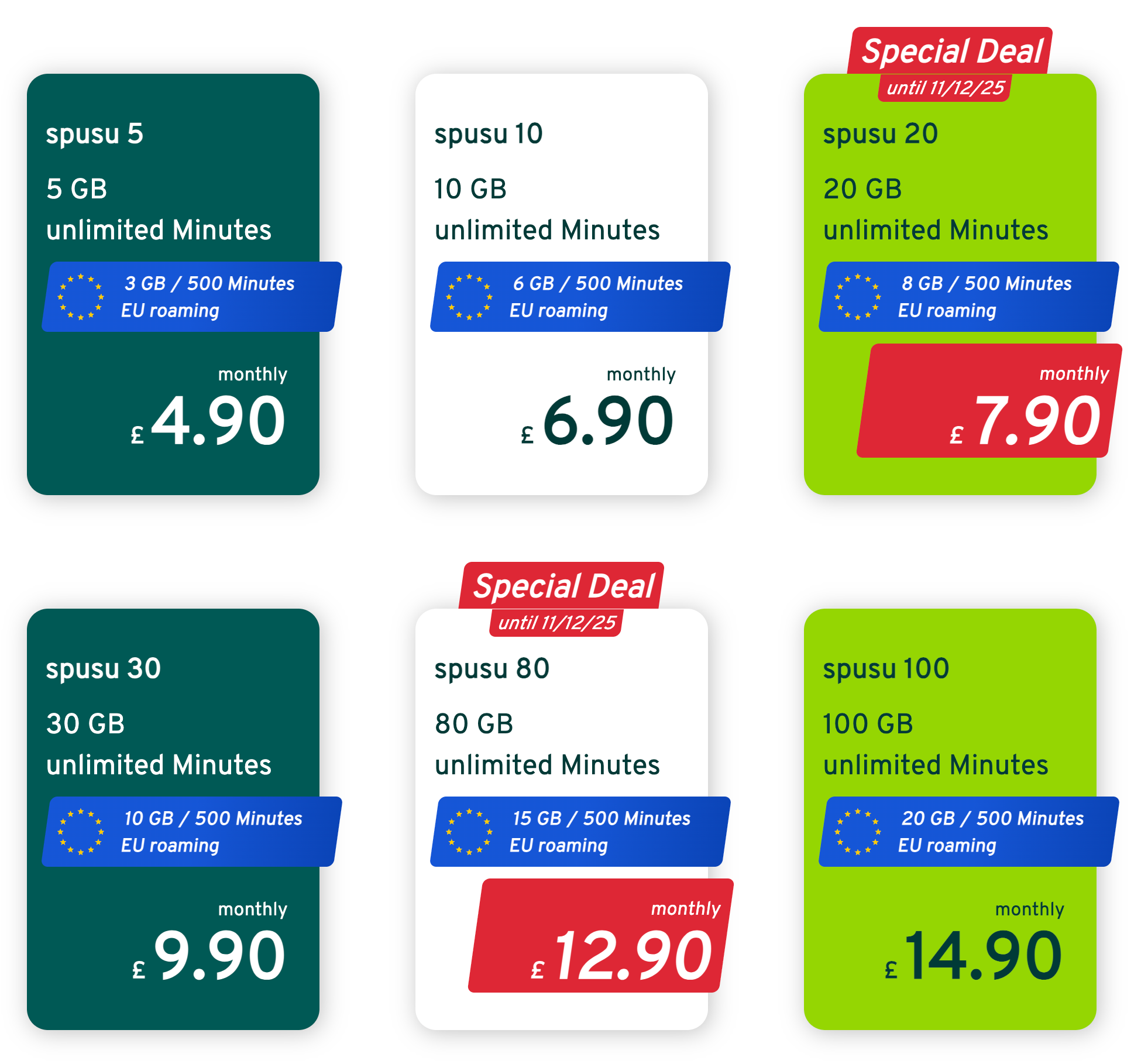
My favourite is this one – spusu 5. I think I need this one for my iPad. Yes, I don't make calls on it but I'm currently using a Smarty data-only eSIM in that and that's £5 for 2GB...
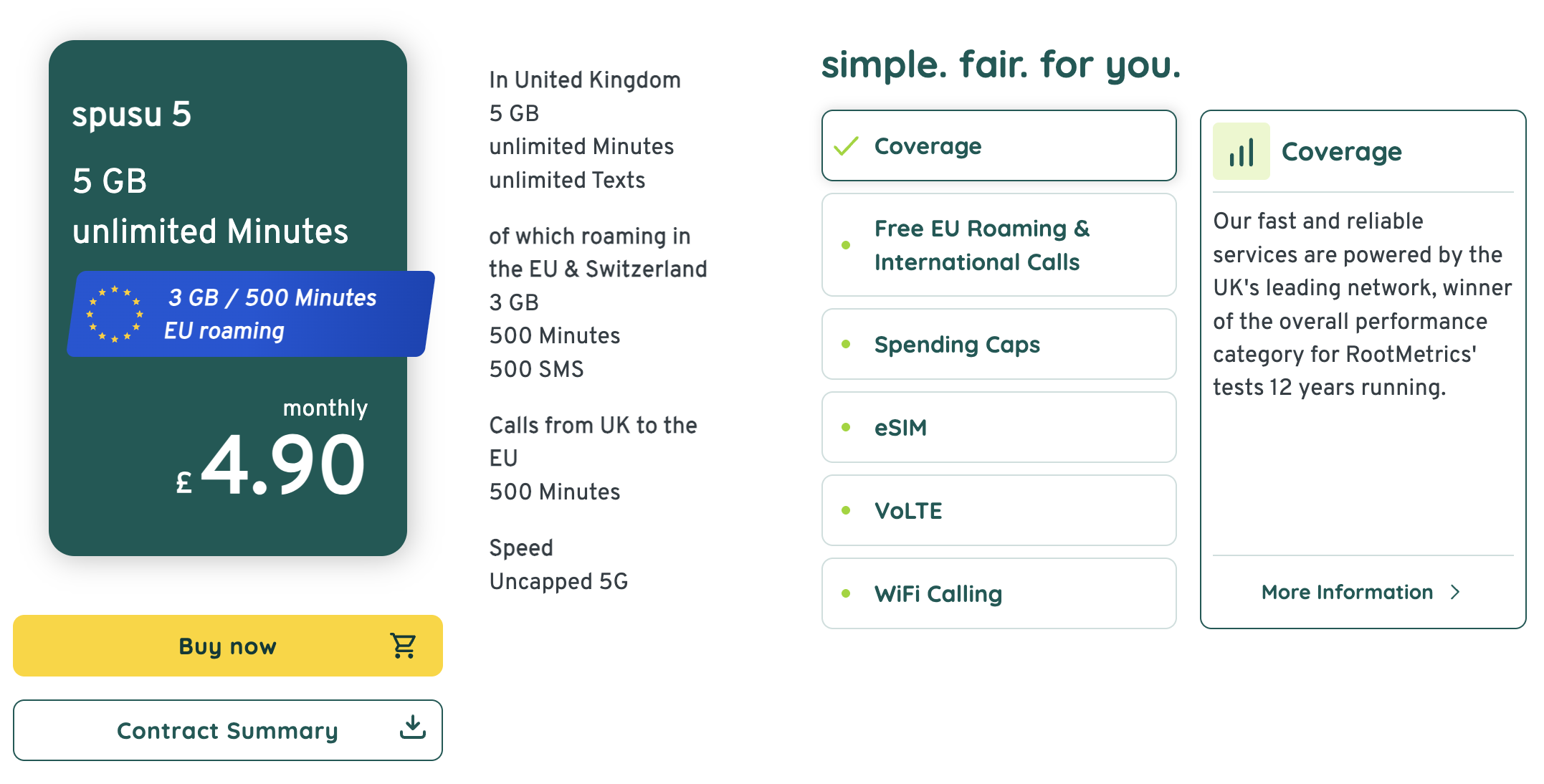
Under £5 for 5GB and unlimited minutes... and you get EU roaming.. and an eSIM? Like it!