Re-engagement, AI & Mobile Apps: A Q&A with Moloco’s VP EMEA
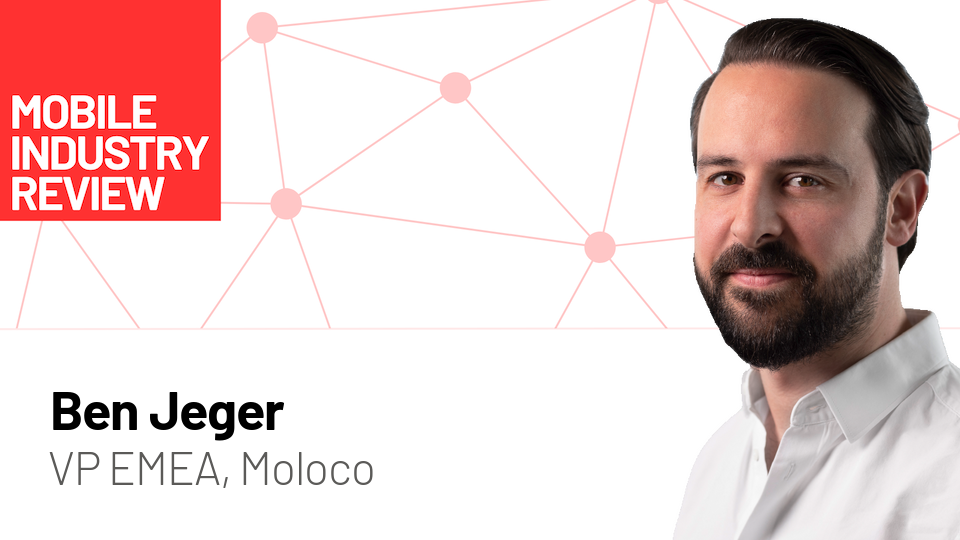
Today we're meeting Ben Jeger, VP EMEA at Moloco. They specialise in AI-powered advertising solutions that empower businesses across mobile apps, e-commerce, and streaming media to grow.
Over to you Ben - my questions are in bold:
Who are you and what's your background?
Born in Frankfurt to a British mother and Israeli father, I later moved to the UK to study Management in Manchester. I then began my career in IT Hardware distribution – buying and selling servers and switches at a time when cloud computing was emerging. While visiting friends in London, I met my wife, who was living there at the time. Her career later brought us to Munich. A chance encounter at a Google conference led me to Sponsorpay (later Fyber, now part of Digital Turbine) and Berlin, launching me into the world of Mobile App Performance Marketing - an area I've worked in ever since.
On a business trip to Israel in 2012, I connected with Oren Kaniel, the CEO of the newly founded AppsFlyer. Years later, Oren invited me to open AppsFlyer's Berlin office, where I went on to lead Central Europe as Managing Director until I joined Moloco in 2022.
What is your job title, and what are your general responsibilities?
I'm VP EMEA at Moloco. My responsibilities centre on revenue growth for the region, but just as importantly, building and developing the team to make that growth possible. That includes hiring, creating career progression opportunities, and ensuring the right structure is in place as we scale. I'm also closely involved in client pitches and relationships, as well as acting as the voice of the customer internally for product development.
Can you give us an overview of your business and what drew you to lead the organisation?
My path to Moloco began through a former colleague from Fyber who had joined the company and reached out to me. Initially, I was hesitant because I'd worked in media before and didn't want to return to the traditional media space. However, everything changed when I had the opportunity to speak with Ikkjin Ahn, Moloco's co-founder and CEO.
When he explained Moloco's foundations and approach, it became clear it's a machine learning and AI company first and foremost, with roots in engineering and deep tech. I was struck by how it's channelled that expertise into performance advertising, helping businesses reach the right audiences with accuracy and scale. But what really drew me in was the impressive people at Moloco.
Having collaborated with some of the best and brightest in the industry, I've learned that for me, the most rewarding part isn't just the work, but being surrounded by smart, talented people who push me to grow. That's what ultimately led me to Moloco.
Who are your target customers? What's your revenue model?
Moloco's roots are in mobile app advertising for gaming, and we've built a strong reputation in that space. But over time, our technology has proven just as powerful for consumer apps, retail media, and streaming. Moloco operates on a performance-based revenue model, earning a percentage of ad spend from clients.
This approach ensures that Moloco's success is directly tied to delivering measurable results, such as improved return on ad spend (ROAS), while helping clients unlock the full value of their first-party data. Our AI-driven products – Moloco Ads, Moloco Commerce Media, and Moloco Streaming Monetization – are built to help companies put their own data to work, running personalised campaigns that really connect with their audiences.
What's the most challenging problem your team has solved recently?
A big challenge we've been tackling is helping mobile apps move from just acquiring users to actually bringing them back. Drop-off rates are high across the board, so keeping people engaged after install has become just as important as getting the install in the first place.
We've built new AI-driven re-engagement models that learn faster and do a better job targeting lapsed users with real intent. We're already seeing the impact, with our partners getting up to 15% better ROAS and 12% lower Cost Per Acquisition (CPA). Our top five gaming partners are a good example. They're now spending three times more on re-engagement than their peers because smarter targeting and quicker learning cycles are giving them more value from every dollar spent.
If you had a magic wand, what one thing would you change in the mobile industry?
If I had a magic wand, I'd remove the perception that advertising outside of Google and Meta is complicated or difficult to navigate. For many mobile apps, those two platforms feel like the default. Marketing teams already know how to use them, and the audience is there. But the reality is that there's huge unexplored potential beyond those walled gardens.
The tools for advertising in the independent app ecosystem are just as straightforward, and the reach is massive – billions of devices worldwide, often with access to higher-value users and less competition. Apps in gaming, ride-hailing, food delivery, health and fitness, and more are already seeing great results. But for many others, it's still a blind spot. If I could change one thing, it would be making that shift feel less daunting, because it really is easy and the payoff is substantial.
What is your message for the larger players in the mobile industry marketplace?
I'd say don't overlook the opportunity right in front of you. Right now, research shows that 88% of consumer mobile app ad spend still flows to Google and Meta, but user attention has shifted. The independent app ecosystem reaches more than two billion daily active users. This is on par with TikTok and Instagram combined, yet it remains massively underutilised.
The mobile industry leaders who diversify beyond the familiar platforms are already seeing stronger performance, in some cases seeing up to 214% higher returns on ad spend. While competition and costs keep rising in the walled gardens, the reality is that high-value users are spread across thousands of independent apps. Targeting that key audience is crucial to capturing unrealised revenue today.
Where do you get your mobile industry news from?
I'm subscribed to Eric Seufert's Mobile Dev Memo Newsletter, which provides weekly insights into all things mobile - marketing, monetisation, and ecosystem trends. I'm also part of his Slack group, where people in the mobile space exchange ideas and resources on marketing, analytics, and strategy.
I stay up to date with several other Slack groups, such as "Two & A Half Gamers", whose podcast and Slack community offer practical insights into user acquisition, game design, and ad monetisation. And of course, one of my most valuable sources is right at home. At Moloco, we have a very tuned-in global team who share news from around the globe. That collective knowledge gives us a unique perspective on how trends are playing out worldwide and helps us anticipate shifts earlier.
Can you list 3 people you rate from the mobile industry that we should be following on LinkedIn, and why?
As I referenced above, Eric Seufert is an Ad Ecosystem expert who is definitely worth following. I'd also recommend following the people behind Two & A Half Gamers (Matej Lancaric, Felix Braberg and Jakub Remiar), as well as subscription app guru, Thomas Petit.
What are your go-to mobile apps for both work and personal use?
At work, Glean has become indispensable for finding internal documents, conversations, and information across systems faster. Slack and WhatsApp are my primary channels for internal and external communication. And ChatGPT and Gemini have almost entirely replaced Google Search, as they provide faster, more direct answers. In my downtime, I use Duolingo for language learning and more recently, chess.
Tell us about your approach to mobile devices - what do you use and what drives your upgrade decisions?
My journey started with Nokia, Blackberry, and Google Nexus, and then I was a die-hard Android person, until a friend won a raffle for the brand new iPhone 14 Max a couple of years ago and gifted it to me. He wanted to convert me to iOS, and he succeeded, but I haven't bought a new phone since. I'm still using it despite one of the camera lenses being broken.
What's the best new mobile technology product or service you've seen recently?
It's crazy that we all seem to have gotten used to having several super assistants in our pockets. This question reminded me of how recent the development of highly capable chatbots is. I'm still genuinely impressed by them and how they keep getting better every month.
Finally, let's talk predictions. What trends do you think are going to define the next few years in the mobile industry?
One of the biggest shifts we're seeing is that regardless of industry, every business is now a mobile app company. Consumers live in apps and hop between gaming apps, productivity tools, social platforms, niche communities and more throughout their day. Consumer attention has moved away from Google and Meta, and the mobile app ecosystem has become fragmented. This is reshaping how businesses think about monetisation, engagement, and global expansion.
That fragmentation used to be a challenge, but now it's an opportunity. We're seeing the rise of sophisticated ad tech, better measurement tools, and more refined targeting capabilities across millions of apps that were previously considered too dispersed or small to matter. Having the right partners will be key – ones who get how this new mobile world works and can help businesses actually reach the people in it.
Thank you Ben. Connect with Ben on LinkedIn and read more about Moloco at their website.