Where AI Meets the Call: Al Balasco on the Next Wave of Digital Communications
Al Balasco discusses Radisys's role in transforming telecom through open platforms, AI-enhanced communications, and 5G new calling innovations deployed across 200+ operators globally.
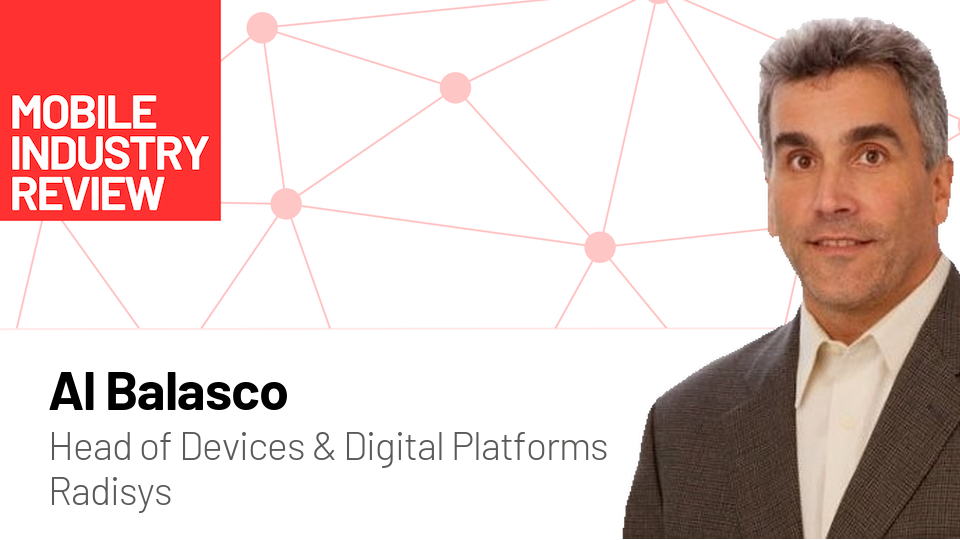
Al Balasco leads the Devices and Digital Engagement Platforms Business at Radisys, where he oversees a portfolio spanning media servers deployed across 200+ operators globally to AI-powered communication services.
I asked Al for his view on how AI is reshaping communications networks, and why open platforms are becoming critical to the next phase of telecom innovation.
My questions are in bold - over to Al:
Who are you and what's your background?
I went to Northeastern studying journalism and political science. I took a public relations role at Psion, a British handheld device manufacturer, following graduation, in order to earn some money as I prepared for the LSAT. The technology hooked me and completely changed my path. In time I expanded beyond public relations and corporate marketing into product management. Since then, I've spent my entire career in high tech, working with startups, mid size firms and in the Fortune 500 at Avaya before joining Radisys in 2010. Along the way, I earned my MBA from Northeastern in 2002 and never looked back. I've been in my current role here since 2017.
What is your job title, and what are your general responsibilities?
I am the Head of Devices and Digital Engagement Platforms Business for Radisys. My role carries P&L responsibility for a category of products, primarily centred on our media server business. I've overseen the expansion of this portfolio, including the Engage Digital Platform product line, and integrated a previously separate devices group into the business. By bringing together teams with expertise in device application development and mobile operating systems across phones, IoT, and POS devices, I manage a unified portfolio that spans the end user experience to the core network, strengthening our market position anchored in our unique expertise and market leadership in real time communications with our media server, which is deployed in over 200 operators globally, as well as through independent software vendors who build enterprise communications applications.
Can you give us an overview of your business and what drew you to lead the organisation?
I joined Radisys in 2010, coming from Avaya by way of an earlier acquisition of Spectel, where I worked in product management. One of my main responsibilities there was figuring out how to move our vertically integrated, PSTN-based conference bridge to an IP-enabled platform. That work led me to partner with Convedia, a Vancouver based company which had an IP-based media server. We built a strong relationship and even closed a solid enterprise deal together. I continued working with their team for many years until Radisys acquired them in 2006. So, joining Radisys, and working with the ex-Convedia team, was like a homecoming.
Radisys is a global leader in open solutions, and a lot of my work centres on helping service providers take advantage of disaggregated platforms, open standards, and flexible software and hardware so they can modernise their networks quickly and cost-effectively. What makes Radisys unique is the breadth of our portfolio—everything from digital endpoints to open broadband and wireless access, supporting terrestrial, non-terrestrial, and edge environments, along with our digital engagement platforms. All of these pieces come together to help our customers create differentiated services, improve performance and scale, and lower total cost of ownership. And at the core of it all is our "Open Radisys" commitment, which really drives how we approach innovation and partnerships across the industry.
We are at the heart of the convergence of AI and communications, where we bring the capabilities of generative AI to media rich communication services, providing high value to our customers and their customers customers. We are leading a new wave of communications innovation, service monetisation, and, not the least, high impact societal benefits. As an example we have launched an in telecom network application called clarity, which improves the intelligibility of phone calls for individuals with hearing loss. It's device independent, personalised to the user's unique hearing deficiencies, and typically costs the user less than price of a cup of coffee a month. And the impact is incredible: users who might otherwise socialise less, which can lead over time to other health issues, can re-engage with friends, colleagues and loved ones. Over 20% of the world's population is affected by hearing loss, and with aging populations, this number will grow.
Who are your target customers? What's your revenue model?
Our core customers are telecom operators, everything from the largest global providers, like Jio, to tier-2 and tier-3 operators and MVNOs. Our media server is deployed at more than 200 operators worldwide, often through channel partners like Nokia and Mavenir, and we also have enterprise customers using the technology. What they all have in common is the need for highly reliable, real-time, media-centric solutions.
As we've extended the portfolio with EDP, our offer has broadened. In addition to our traditional operator business, this platform and its tools allow enterprises, systems integrators, and application developers to build sophisticated communications capabilities without needing deep telecom expertise. That opens adjacent markets and new applications, like Industry 4.0 services, where communications isn't the centrepiece, but a high-value feature extension to a business process focused application. This combination of telecom-grade reliability and developer-friendly tools is what lets us support both our traditional customers and a growing set of new ones.
What's the most challenging problem your team has solved recently?
One of the biggest challenges that is resolving hasn't been technology related; it's been a shift in industry mindset. New services have historically taken a long time to move from concept to launch, but we've worked closely with service providers who are more willing to experiment at a small scale, learn quickly, and adapt. That shift has been essential to getting new innovative services to customers. At the same time, we've also had to build greater awareness of Radisys as a player in the digital application space, which involves engaging a completely different set of customer stakeholders than with our media server offer.
If you had a magic wand, what one thing would you change in the mobile industry?
If I had a magic wand, I'd push to further accelerate the pace at which new mobile technologies are adopted and deployed. Right now, the industry often waits for standards to be fully finalised before rolling out services, which slows innovation. RCS messaging is a recent poster child of the impact of this approach. I'd enable a balance where service providers could combine emerging standards with "pre-standard" capabilities to move faster, while still ensuring interoperability. For example, with 5G new calling, we're delivering richer, interactive in-call experiences today, even as the broader ecosystem takes time to fully support the standards. This gives customers a head start while guaranteeing eventual – and seamless - compliance with the ratified standards.
What is your message for the larger players in the mobile industry marketplace?
Our message to the larger players in the mobile industry is that collaboration is key. We work closely with all major vendors, even as customers mix and match technologies, and we believe the same approach applies to 5G new calling. By cooperating on both standards and pre-standard solutions, we can help customers deploy innovative services today while ensuring their investments seamlessly carry forward into the full 5G new calling ecosystem.
Where do you get your mobile industry news from?
I stay informed through a mix of mainstream business press like The Economist, WSJ, NYT, and Washington Post, focusing on the business side, as well as industry-specific updates from vendors and analysts. Outside of those regular reads, for technology and more narrow market information I seek, I tend to be more ad hoc, using AI, traditional search, or Linkedin to find articles, papers, podcasts, people, or other sources of topic specific information to get a well-rounded view of trends and developments in the mobile industry, rather than regularly read or listen to a small subset of go-to sources.
Can you list 3 people you rate from the mobile industry that we should be following on LinkedIn, and why?
- Rob Kurver: He and his partners have created a consortium that combines a strong commercial and ROI-led perspective with key technologies, applications, and tools for high-value services—helping educate the communications services provider community on the value they and their customers can derive in the new world of digital, AI-powered services.
- Dean Bubley: Perceptive, entertaining, and contrarian—while consistently providing thought-provoking and substantive takes on the industry.
- Cassie Kozyrkov: Provides wide-ranging, insightful posts on AI technology, including its social impacts, applications, and broader implications.
What are your go-to mobile apps for both work and personal use?
I prefer keeping apps minimal and focused. For work, I primarily use Teams and Outlook; for personal use, YouTube, Netflix, and Apple TV. WhatsApp spans both work and personal use. I'm excited about 5G new calling, which could integrate voice, AI, and rich interactive content into a single experience without the need for multiple downloads or app management.
Tell us about your approach to mobile devices - what do you use and what drives your upgrade decisions?
I'm in the Apple ecosystem, so I upgrade my iPhone every couple of years, usually driven by performance improvements, and occasionally for new features. I also regularly use my iPad for content consumption while travelling, a Kindle to make time for reading, and a Remarkable tablet for distraction-free notetaking, which lets me quickly convert handwritten notes to text without needing my PC. In addition to the Kindle I have one other break from the Apple ecosystem, and that's a Garmin Smartwatch.
What's the best new mobile technology product or service you've seen recently?
The pace of innovation in mobile technology is incredible, making it hard to single out one product. What excites me most are network-delivered, AI-enhanced services, like those enabled by our Engage Digital Platform, that can be rolled out at scale, updated quickly, and reach all users regardless of device. This approach leverages network performance and privacy advantages, allowing the latest software innovations to be accessible without depending on device upgrades or user cost.
Finally, let's talk predictions. What trends do you think are going to define the next few years in the mobile industry?
Perhaps as an extension to the prior question, but with a view to what's on the horizon and is likely to be industry changing, I'm also following the evolution of AI-enhanced wearables though outside of experiencing hands-on demos at trade shows and the occasional retail sighting, I haven't pulled the trigger on purchasing a device just yet for myself. But the potential for augmenting the real world with relevant, contextual information, and capabilities that I can interact with even more conveniently than a phone, but that is also enhanced by my preferences, experiences, history, and personal information, has some pretty compelling potential. It will be interesting to see whether these evolve as a more general companions or substitutes to the mobile phone, or they will tend to apply to more narrow, specialised business and personal use cases. And how privacy, security, and regulations affect uptake as well.
Thank you to Al for taking the time to share his insights with us here at Mobile Industry Review.
You can learn more about Radisys and their open telecom solutions on their website.