From Connectivity to Opportunity: Inside GSMA’s Mobile for Development Mission
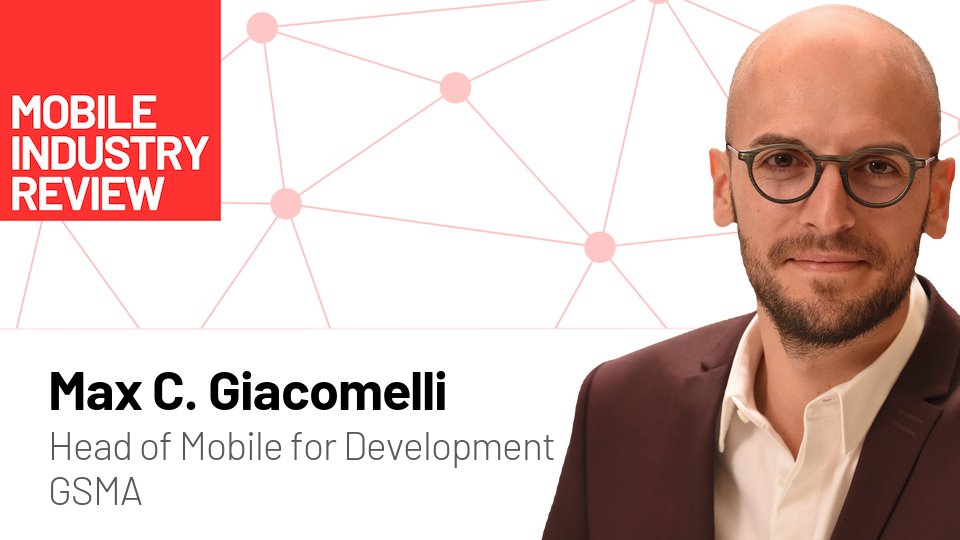
Today we're meeting Max Cuvellier Giacomelli, Head of Mobile for Development ("M4D") at GSMA.
Now I recognise many reading will instantly jump to assuming the word "development" in Max's job title is something about writing code. No. It's the other sort of development – helping people and their communities create better quality lives, through the use of (mobile) technology.
It's a brilliant initiative of the GSMA and I'm delighted to be bringing you this Q&A with Max. His passion absolutely shines through in his answers and I have to say, it's fantastic to see GSMA supporting the M4D mission. Have a read of Max's answers below to get a good overview on some of the projects he and the team have been working on recently.
Over to you Max - my questions are in bold:
Who are you and what's your background?
I'm Max Cuvellier Giacomelli, Head of Mobile for Development at the GSMA. I began my career in telecoms strategy consulting before joining Orange's Middle East and Africa innovation unit, where I helped design products and services to unlock new opportunities for users and new business opportunities for affiliates of the group.
When I joined the GSMA in 2012, I found a community equally committed to using mobile technology to create sustainable lasting change. I started working on the Connected Women programme, then headed the Ecosystem Accelerator and Digital Utilities programmes, where we allocated grant funding to 85 ventures across Africa and Asia which went on to impact more than 10 million people.
In early 2020, I moved into my current role as Head of Mobile for Development, where I lead an incredible team of over 130 experts operating at the intersection of the mobile ecosystem and the development sector.
What is your job title, and what are your general responsibilities?
As the Head of Mobile for Development at the GSMA, my role is to bring together the mobile industry, the development community, innovators and governments to harness digital innovation in ways that increase digital and financial inclusion, strengthen climate resilience, support impactful use case of AI, and empower underserved communities.
Our work focuses on three main areas. Inclusion to enable digital, financial and gender inclusion through mobile connectivity. Innovation, supporting practical solutions in sectors such as humanitarianism, climate resilience and urban services. And scale, to support promising technologies and business models reach long-term commercial sustainability.
With partners, to date, the initiatives we have supported have reached over 260 million people in low- and middle-income countries, helping to bridge the digital divide and unlock opportunities, but there's still a lot more work to do.
Can you give us an overview of the GSMA?
The GSMA is the trade body representing the global telecommunications industry. Through its Foundation and Mobile for Development programmes, it works to leverage mobile connectivity to address the challenges faced by our communities, our economies and our planet with solutions whose business models have the potential to scale.
Mobile connectivity can be a very powerful equaliser. It is a true force multiplier: when paired with the right solutions, it expands access to critical services, strengthens local economies, and accelerates social impact at scale. Whether improving how people learn, work, access healthcare or adapt to climate challenges, mobile has an unparalleled ability to extend opportunity to those who have historically been left out. Through combining industry expertise, innovation and mission-driven collaboration, we can create meaningful and lasting impact for millions of people.
Who are your target customers? Tell us more about Mobile for Development?
The GSMA's work is focused on uniting the global mobile and telecoms sector and expanding collaboration across industries. It is funded by our members and associated members through membership fees, as well as the margin on our world-class events.
Mobile for Development specifically is funded through the GSMA's Foundation which itself is largely funded through partnerships with forward-thinking donors and development agencies, most notably the UK FCDO and Sida. The GSMA also provides direct support to the Foundation, enabling us to run programmes, manage our innovation fund, and support start-ups and operators in low- and middle-income countries. We also ensure that the solutions we help develop are designed with a clear business case in mind, so that once the initial funding is in place, the models can stand on their own two feet.
What's the most challenging problem your team has solved recently?
I would like to take this opportunity to highlight the work of one of the grantees we have supported (with non-dilutive capital and technical assistance) through our GSMA Innovation Fund for Climate Resilience & Adaptation:
In Nigeria, nearly 40% of the population works in agriculture, yet farmers face unpredictable weather, limited access to inputs and rising food insecurity. With our support, Nigerian agritech Crop2Cash launched FarmAdvice, an AI-powered national hotline that farmers can call on any phone, at any time, to receive personalised agricultural guidance in English, but also Hausa or Yoruba. It uses a fine-tuned SLM built on local agronomic and weather data to deliver practical, climate-smart advice. It is a simple but powerful 'small AI' solution - as more and more people are calling these - that helps farmers make better decisions, reduce losses and improve their livelihoods.
This is part of a broader body of work Mobile for Development is supporting focused on AI, including our GSMA Innovation Fund for Impactful AI. This also fits into a larger body of work at GSMA - before M4D - including the recently-launched "AI Language Models in Africa, by Africa, for Africa" initiative. Working together with operators, researchers and innovators to build inclusive African AI models that reflect local languages, contexts and needs, we can help ensure Africa becomes a leader in the development of AI to improve the accuracy and relevance of the technology for the region. This is essential to creating a more equitable and resilient digital future across the continent.
If you had a magic wand, what one thing would you change in the mobile industry?
One of our core goals is to collectively bridge the Usage Gap and achieve true connectivity for everyone. Today, around 3.4 billion people, or 42% of the world's population, still do not use mobile internet.
This is not so much a coverage problem. 96% of the global population are now in fact covered by mobile broadband, 3G and above. It is a usage problem, with the Usage Gap 10x the size of the Coverage Gap (3.1 billion vs. 300 million), and the core development issue we set to tackle.
This issue is driven by a set of critical barriers to adoption: the cost of smartphones and data, limited digital skills, low levels of confidence and safety online, and a lack of relevant local content and services, as well as infrastructure gaps, such as unreliable electricity. These are also compounding existing disadvantages and digital divides for women, those living in poverty, rural communities, and people with disabilities.
We are making progress, through a strong focus on handset affordability, initiatives such as the GSMA's Mobile Internet Skills Training Toolkit, as well as using AI positively to support the creation of local languages services and accessible relevant content for underserved communities we're seeing through key industry partnerships, such as VEON, Beeline Kazakhstan, and the Barcelona Supercomputing Center.
Closing this gap is about more than just getting people online. It's about meaningfully improving the lives of underserved communities and enabling them to be part of the modern economy and digital world.
What is your message for the larger players in the mobile industry marketplace?
Industry collaboration will enable our digital futures. Mobile connectivity has become the foundation of products and services worldwide, and the decisions we make now, as an industry, and more widely, will determine the inclusivity and accessibility of the digital world and modern economy moving forwards. Large players have the ability to set the tone on alignment, responsible innovation and long-term investment.
By prioritising interoperable standards, trusted partnerships and shared approaches to inclusion, we can create an ecosystem that not only drives commercial opportunities and makes lasting contributions to society, but connects everyone and everything to a better future, unlocking opportunities for all.
Where do you get your mobile industry news from?
For mobile industry news: Mobile World Live, Tech Africa News, Developing Telecoms, GSMA intelligence For Tech for Development news: Devex & partner newsletters.
Can you list 3 people you rate from the mobile industry that we should be following on LinkedIn, and why?
There are so many brilliant people across the mobile industry, but three that I would really encourage others to follow - assuming you're already following our Director General, Vivek Badrinath, of course - are Nompilo Morafo, Elsa Muzzolini and Kaan Terzioglu, as they have deep expertise in the telecom space, but also translate this expertise into tangible impact on the ground:
- Nompilo Morafo is the Chief Sustainability & Corporate Affairs Officer at MTN where she has been leading this portfolio for the past 7 years. MTN is a strong partner of ours, and her commitment to making sure that the nearly 300 million customers MTN serves across 19 markets exemplifies how mobile operators can have a tangible impact on local communities and economies. Nompilo is not alone in pushing this strong agenda of course: she works with a great team, and has support from her CEO Ralph Mupita who I would also recommend following.
- Elsa Muzzolini is the CEO of M-PESA in Ethiopia (and full disclosure: an ex-classmate). She has extensive experience across the continent (Cameroon, Uganda, Nigeria…) deploying and running mobile money, which is a core component of the digital value proposition of mobile operators in Africa. Following her is an opportunity to better understand what growing one of those services in a high-potential market looks like.
- Last but not least, Kaan Terzioglu is the CEO of VEON, and the Chair of our GSMA Foundation. I am inspired by how he constantly pushes the envelope, looking for new partners and ideas to maximise the impact of VEON's work, whether it is by launching an LLM in Kazakhstan or by maintaining connectivity for the population in Ukraine.
- I would also recommend following Hande Asik who works very closely with Kaan as his Chief Strategy and Communications officer.
All of them represent the kind of leadership our industry needs more of. They are driving innovation, certainly, but they are also helping to make the industry more inclusive, more human and more connected in every sense of the word.
What are your go-to mobile apps for both work and personal use?
I'm probably not the best person to ask as I'm pretty old school: I like simple no-frills tools . For instance, I manage my to-do lists in Reminders on iPhone through my own system of lists, hashtags etc. It's simple, synchronises automatically between devices, and beats the other to-do-list management tools I've tried over the years.
Tell us about your approach to mobile devices - what do you use and what drives your upgrade decisions?
I have been using Apple products since the age of 6.
My dad was an early adopter and equipped his dental practice with Macs when he opened it in the 80s, so there were always hand-me-downs to play with at home. I've only used PCs for a couple of years while in business school (the network wasn't compatible with Macs at the time), and let's say it wasn't for me.
My first job ever - a one-year internship - was with Apple and I learned so much in terms of how to use Apple products and tools that it would be hard to convince me to migrate to a completely new environment for me.
I'm currently using an iPhone 14 Pro and I just upgraded to a 13-inch MacBook Air. I believe in simplicity, so I only have one laptop and one smartphone. My approach is to only replace the device if productivity becomes impacted by obsolescence, which I try and delay by keeping the OS and apps updated, and regularly cleaning up memory, unused apps etc.
I keep my iPhone home screen to one page only and all notifications are off except for WhatsApp: no vibration, my phone is almost always on silent, and even the attention-seeking 'badges' are a no-go for me. This is what works for me.
What's the best new mobile technology product or service you've seen recently?
Through the work we do with our Innovation Funds, I'm privileged to come into contact with great local innovations that leverage technology to improve local communities' lives, and those are the ones I'm most excited about. I was recently at MWC Doha where I got a chance to meet with the founders of WonderTree, a Pakistani start-up designing AI-powered educational modules for children with special needs.
I also reconnected with Haroon of Taleemabad who is equipping local families, schools, and government with the right tools to improve educational outcomes, also in Pakistan. Those are only two examples of how technology can be a force for good.
Finally, let's talk predictions. What trends do you think are going to define the next few years in the mobile industry?
The next few years will continue to be defined by AI, which brings both risk and opportunity. However, we must ensure AI becomes part of the solution towards true connectivity for all and a force for inclusion rather than a new source of inequality, to help billions of people get online.
Without intervention, the digital divide could quickly harden into a permanent divide, with both a Usage Gap and an AI Gap leaving those in overlooked communities on the outside, while others gain the skills, tools and access to thrive in a digital society.
The challenge for us all is to ensure that AI contributes to improving access and use of digital services across the value chain, while making networks more efficient, enabling services in local languages, and creating relevant accessible content, helping to bridge the Usage Gap and not compound it.
Implemented responsibly, AI offers us a unique opportunity to establish a foundation that truly reflects the diversity of the world and help provide accessibility for all, creating a digital era more equitable than the last.
If we can ensure meaningful connection for all, and AI that positively supports the removal of existing barriers to connectivity, we can enhance individuals' potential everywhere, and strengthen communities' resilience to economic shocks, public health crises and climate-related challenges, for transformative change globally.
Thank you Max. Brilliant work and super overview!
Connect with Max on LinkedIn and read more about GSMA at their website.